Why yin yoga and fascia work will literally make you younger
Most of what we call "getting old" isn't ageing, but the accumulation of decades of bad habits. And a surprising amount of what we call ageing is actually our bodies drying out.
For a long time, I had ageing completely backwards.
I assumed it was something you simply accept. The weight that starts to accumulate on your midsection. The energy is just not quite there. The neck hump grows as we keep staring our screens. Stiffness, aches and pains don’t really leave the body anymore and you just learn to live with them.
That’s what getting older is, I thought.
But it isn’t exactly age that causes most of these things. It’s the decades of sedentary lifestyle, shallow breathing, moving the same few directions, inadequate rest… I don’t need to go on, we already know we shouldn’t be doing these things.
But habits, compounded over years, can either quietly wear a negative pattern into the body, or if we choose to add better habits, they can start weaving a more positive pattern.
My hot take is that not only are are practices that can slow down the progression we call ageing, but some will quite literally make you younger — through hydration.
You don't get stiff because you get old — you get old because you get stiff
Joseph Pilates said you're only as young as your spine is flexible. Taoism, the tradition behind yin yoga stretches that follow meridian lines, puts it more bluntly: the flexible outlive the rigid.
In Traditional Chinese medicine, ageing is understood as your tissues slowly stiffening as they lose their fluids and dry out, the body going from supple and moist to dry and brittle.
And here's where it stops being philosophy and starts being chemistry.
The day you were born, your body was approximately 75 % water, even more if you were born prematurely. By the time you’re old, that number is closer to 50 %.
Life is a slow evaporation.
An older body is drier: less fluid in the tissue, less glide between the layers, less give when it moves. And you know what happens to dry leaves — it does not take much to crunch them broken in your fist. Similarly, the dry and brittle texture of older tissues makes them more prone to stiffness and injury.
The anti-ageing industry knows this.
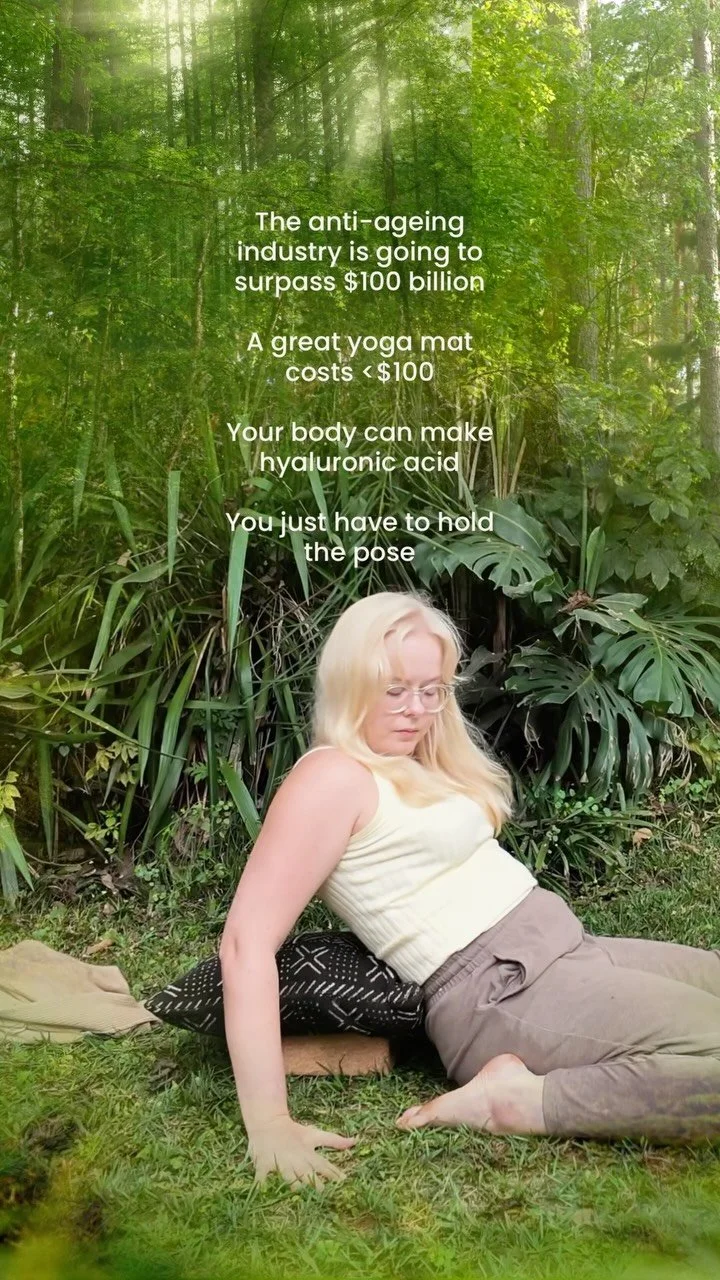
Hyaluronic acid — the thing in your serum, the molecule the entire anti-ageing industry is built on as it marches toward a hundred billion dollars — holds water in tissue.
But what if I told you that your body can actually make one of the main ingredients in your serums? You are quite literally a moisturiser factory, as long as you call your cells to their shift, and perhaps invest in a yoga mat.
Yin yoga is a precision practice for healthy ageing
Yin yoga is so much more than gentler yoga. It is one of the few practices that replenishes your fluids from the inside.
A thirty-second stretch before or after high-intensity exercise reaches your muscles, warms you up, and then you move on. It never sits on the deeper connective layer long enough to ask anything of it.
But yin yoga does.
As you hold a passive shape for a few minutes with the muscles deliberately switched off, the load travels past the muscle and into the fascia underneath. The factory turns on, as your cells start producing hyaluronic acid that luibricate joints and add mobility.
And not just that — it also stimulates new collagen production that builds joint stregth and resilience. One hold, two jobs.
Hydrate without strengthening and you get loose, vulnerable tissue. Strengthen without hydrating and you get powerful, brittle tissue. Supple and strong. That is, more or less, the definition of young connective tissue.
If you’re the type that trains hard at the gym or running path, you may need to hear this most. Your fascia gets powerful load during your workouts. Add a desk job, and you get hours of other type of load, both densifying your tissue. The result might be the strong-but-perpetually-tight athlete.
That long, slightly boring, slightly uncomfortable hold in yin yoga isn't a lack of intensity. It's the precise stimulus the tissue rarely ever gets. This counterbalance keeps the tissue usable: hydrated enough to glide, resilient enough to last.
Calling yin "gentle yoga" is like calling a long marinade or a simmering stew lazy cooking. The whole effect comes from the slowness.
One honest caveat: a single class can give you a real, immediate sense of release, but lasting change is slower. It takes repeated holds over weeks and months, a habit. Just like those bad habits that made you age before it was time.
This is a practice, not a treatment.
So — will yin yoga make you younger?
Whether the long stretches of yin yoga, or deliberate fascia work will literally make you younger depends how you define young.
If part of what you mean by young is how hydrated, supple and mobile your body is — how easily you move, how little you ache, how well your tissue takes a load — then yes. And that is something you can affect at more or less any age.
Life is a slow evaporation. Yin yoga is one of the few practices that slows it down.
You just have to hold still long enough to let it.
I teach Yin Yoga and FasciaMethod for fascia health, mobility, and ageing well, for wellness spaces and teams building genuine depth into their recovery offering. If this resonated, have a look at my offerings, or get in touch below.